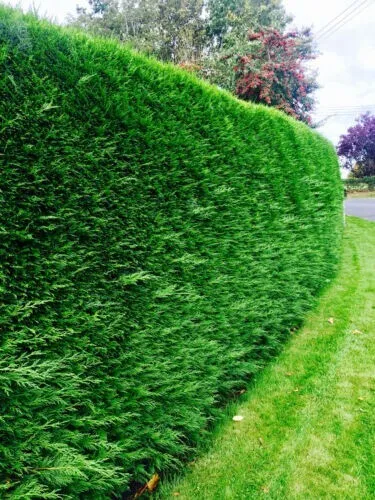
Leylandii (× Cuprocyparis leylandii) is the fastest-growing evergreen hedge you’ll find in the UK. Plant it in the right place, give it a decent start, and you’ll have a private screen in two to three growing seasons rather than the five or six most other evergreens take. That’s the entire reason it’s been the country’s go-to privacy hedge for the last fifty years.
It’s also the hedge people argue about most. Leylandii disputes between neighbours are a regular fixture in the UK press, almost always because the plants were planted too close to a boundary and allowed to grow taller than two metres. A bit of forethought puts both problems right.
This guide covers what Leylandii is, how to plant it, how far apart to space it, how fast it grows, how and when to prune, and the problems worth knowing about before you commit. We’ve been growing hedging at our Portadown nursery in Northern Ireland for over 35 years, so the advice below comes from actually handling the plants, not paraphrasing a textbook.
What Is Leylandii?
Leylandii is a hybrid conifer. It’s a cross between two North American species — Nootka cypress and Monterey cypress — first recorded in Wales in 1888. The parents were being grown on the same estate; birds carried pollen between them, and the hybrid took. Almost every Leylandii hedge in the UK descends from those original crosses or their cuttings.
It’s evergreen, dense, fast-growing, and tolerant of most UK soils including clay and chalk. It handles coastal winds better than most conifers. The downside: it has shallow roots, casts heavy shade, and grows so fast that without an annual trim it will quickly get out of hand.
If you’re weighing Leylandii against alternatives, our types of hedging guide covers the main options side by side.
Leylandii Growth Rate: What to Expect
In good UK conditions — reasonable soil, decent rainfall, full sun — Leylandii will put on 60–90 cm (2–3 ft) of growth per year, sometimes more in the first three years after planting. A 60 cm potted plant will reach 2 m within four years; a bare root whip will get there in five.
That speed is the appeal. It’s also the reason Leylandii causes so many neighbour disputes: a hedge left untrimmed for three or four years can easily clear 6 m, which is taller than most houses.
If you want fast screening but slower long-term growth, look at Cherry Laurel (40–60 cm/year) or Portuguese Laurel (30–50 cm/year).
When to Plant Leylandii
Potted Leylandii can be planted any time the ground isn’t frozen or waterlogged — basically, any month except the worst of winter (December–February in most of the UK). For best results, aim for autumn (October–November) or early spring (March–April) so the roots establish before summer heat or winter cold.
Bare root Leylandii is only available dormant — that’s roughly November to late March. Planting in autumn gives the roots a full winter to settle before the spring growth push, which is why most experienced planters prefer it.
Avoid planting in:
- Frozen ground — the soil structure breaks down and roots can’t establish.
- Heatwaves (July–August) — potted plants will need constant watering and still struggle.
- Waterlogged soil — Leylandii roots will rot.
Leylandii Spacing: How Far Apart to Plant
This is the single question we get asked most often, and the answer depends on the size of plant you’re starting with and how quickly you want a full screen.
For potted Leylandii (60–80 cm tall at planting):
| Goal | Spacing | Notes |
|---|---|---|
| Quick screen (1–2 years) | 60 cm / 2 ft apart | Fills in fastest, costs more per metre |
| Standard (2–3 years) | 90 cm / 3 ft apart | Best balance of cost and speed |
| Budget (3+ years) | 120 cm / 4 ft apart | Cheapest, takes longest to close gaps |
For bare root Leylandii (40–60 cm tall at planting):
We’d plant bare root whips at 45–60 cm / 18 inches–2 ft apart. They’re smaller to start with so you need more plants per metre to get a dense screen, but the cost per plant is much lower.
Always plant at least 60 cm (2 ft) inside your boundary, and ideally more. Leylandii’s shallow roots will travel sideways under patios and driveways, and the foliage will spread as it grows. Planting too close to a neighbour’s fence is the single most common cause of hedge disputes.
If you’re unsure how much hedging you’ll need, our hedge spacing guide for Red Robin uses the same principles and includes a quick calculation example.
How to Plant Leylandii: Step by Step
- Clear the strip. Remove all grass and weeds along the planting line — at least 60 cm wide. Mulch mat or weed-suppressing fabric works well if you don’t want to hand-weed.
- Improve the soil. Dig in a bucket of well-rotted manure or compost per square metre. Leylandii isn’t fussy, but it grows noticeably faster in soil that’s been given a head start.
- Dig the holes. Each hole should be roughly twice the width of the rootball and the same depth. Loosen the soil at the bottom with a fork.
- Plant at the same depth as the pot. The rootball should be level with the surrounding soil, not buried deeper.
- Firm in well. Heel the soil down firmly around the roots to remove air pockets — Leylandii hates air gaps around its roots.
- Water thoroughly. Even in damp UK weather, give each plant a full can. This settles the soil around the roots.
- Mulch. A 5–7 cm layer of bark or compost keeps moisture in and weeds down. Keep the mulch a few centimetres away from the stems.
- Water through the first summer. A good soak once a week in dry spells makes a real difference in year one.
When and How to Prune Leylandii
The only safe window for hard pruning is between April and the end of August. Leylandii doesn’t regrow from old wood — if you cut back into bare brown branches with no green needles, that section stays bare forever. So prune regularly, and never let it get away from you.
For maintenance trimming:
- Frequency: Once a year is enough for a settled hedge, twice a year if you want a really tight formal finish.
- When: Late summer (August) is ideal for the main cut, with a light tidy in June if needed.
- Shape: Slightly tapered — wider at the base than the top. A flat-topped Leylandii hedge shades out its own lower branches and goes thin at the bottom.
- Tool: Hedge trimmer for general work, secateurs for any thicker branches.
If your Leylandii has got out of control and you need to cut it back hard, do it in stages over two to three years rather than all at once. Cut one side hard in spring, leave the other side for the following year.
Common Leylandii Problems
Going thin at the bottom. Almost always caused by the top of the hedge shading out the base. Fix by reshaping to a slight A-frame (wider at base) and letting more light in. Once brown and bare, those lower branches won’t refill.
Brown patches. Usually drought stress, frost damage, or — if it’s a young plant — dog urine. Water deeply in dry spells, protect newly planted Leylandii from harsh east winds in its first winter.
Roots lifting patios. Leylandii roots are shallow and vigorous. Keep plantings at least 2 m from any paved surface, more if the soil is light.
Neighbour disputes. If a Leylandii hedge affects your neighbour’s enjoyment of their property, the Anti-Social Behaviour Act 2003 gives local councils the power to intervene. A complaint is more likely if the hedge is over 2 m and blocking light. Trimming to 2 m or below in May and September keeps most people happy.
Leylandii vs Cherry Laurel vs Portuguese Laurel
| Leylandii | Cherry Laurel | Portuguese Laurel | |
|---|---|---|---|
| Growth rate | 60–90 cm/year | 40–60 cm/year | 30–50 cm/year |
| Ultimate height (if untrimmed) | 25 m+ | 8 m | 8 m |
| Soil tolerance | Wide | Wide | Prefers well-drained |
| Coastal/wind tolerance | Good | Moderate | Very good |
| Maintenance | High — needs annual trim | Low — once a year | Low — once a year |
| Best for | Tall screens, fast coverage | General privacy, low-maintenance | Coastal gardens, formal look |
If you want speed and don’t mind the annual trim, Leylandii is hard to beat. If you’d rather plant once and forget about it, go with Cherry or Portuguese Laurel.
Where to Buy Leylandii Hedging
We grow Leylandii on our own nursery in Portadown, Northern Ireland, and supply it as healthy, well-rooted plants ready to go straight in the ground. Our Green Leylandii pot-grown hedging comes in 5 litre pots at 100–120 cm, with free standard delivery across the UK and Ireland.
Buying potted means you can plant almost any time of year, and you get a fuller plant from day one than you would with a bare root whip.
Leylandii Hedging FAQs
How fast does Leylandii grow?
In good UK conditions, Leylandii grows 60–90 cm (2–3 ft) per year, sometimes more in the first three years after planting.
How far apart should I plant Leylandii?
For potted plants, 90 cm (3 ft) apart gives the best balance of cost and speed. For a quicker screen, plant 60 cm apart; on a budget, 120 cm apart works but takes longer to fill in. Always plant at least 60 cm inside your boundary.
When is the best time to plant Leylandii?
Autumn (October–November) or early spring (March–April) are ideal. Potted Leylandii can go in any time the ground isn’t frozen or waterlogged.
When should I prune Leylandii?
Prune between April and the end of August. Never cut back into bare brown wood — Leylandii won’t regrow from old wood, so that section stays bare permanently.
How do I keep my Leylandii hedge from getting too tall?
Trim once a year (twice for a formal finish), shape it slightly wider at the base than the top, and keep it to 2 m or below to stay within the law and avoid neighbour disputes.
Why is my Leylandii going brown or thin at the bottom?
Usually the top is shading out the base. Reshape to an A-frame to let more light in. Brown patches can also be drought stress, frost, or dog urine on young plants.